
By Sonja Lyubomirsky. 2007.
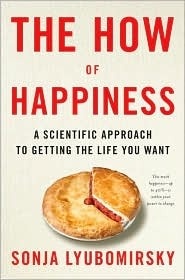
Chapter 2: How Happy Are You and Why?
Our expectations about what our lives should be like are greater than ever before; we believe that we can do anything, and we are profoundly disappointed when reality doesn’t meet or even come close to perfection.
Compared with previous generations, we feel far less belonging and commitment to our families and communities and are thus less buffered by social support and strong meaningful connections to others.
There’s evidence that happy people are somewhat more likely to perceive everything about their lives, including their appearances, in more positive, optimistic ways.
Becoming objectively more beautiful will not make most of you happier. Coming to believe that you are beautiful is another story, and research suggest that this may be one of many happiness boosters.
Happiness Activity No. 2: Cultivating Optimism
But the exercise wasn’t just about imagining a model future for them, it was about building a best possible self today that can make that future come true. Committing their Best Possible Selves to writing enabled them to recognize that is was in their power to transform themselves and to work toward valued goals, that their dreams today and tomorrow didn’t hinge on their spouses or on money or on some stroke of luck.
Because writing is highly structured, systematic, and rule-bound, it prompts you to organize, integrate, and analyze your thoughts in a way that would be difficult, if not impossible, to do if you were just fantasizing.
Writing about your dreams also gives you an opportunity to learn about yourself–that is, to understand better your priorities, your emotions, and your motives, your identity, who you really are and what’s in your heart.
There are many ways to practice optimism, but the one that has been empirically shown to enhance well-being is the original Best Possible Selves diary method. … Visualize a future in which everything has turned out the way you’ve wanted. You have tried your best, worked hard, and achieved all your goals. Now write down what you imagine.
Happiness Activity No. 5: Nurturing Social Relationships
Happy people are exceptionally good at their friendships, families, and intimate relationships. The happier a person is, the more likely he or she is to have a large circle of friends or companions, a romantic partner, and ample social support. The happier the person, the more likely he or she is to be married and to have a fulfilling and long-lasting marriage.
…romantic partners and friends make people happy, but it also means that happy people are more likely to acquire lovers and friends.
…if you begin today to improve and cultivate your relationships, you will reap the gift of positive emotions. In turn, the enhanced feelings of happiness will help you attract more and higher-quality relationships, which will make you even happier, and so on in a continuous positive feedback loop.
…humans are powerfully motivated by a pervasive drive to seek out and maintain strong, stable and positive interpersonal relationships. We strongly resist the breakup or dissolution of relationships and friendships, and without a sense of belongingness, we suffer numerous negative consequences for our physical and mental health.
Happiness Activities
1. Expressing Gratitude
2. Cultivating Optimism
3. Avoiding Overthinking and Social Comparison
4. Practicing Acts of Kindness
5. Nurturing Social Relationships
6. Developing Strategies for Coping
7. Learning to Forgive
8. Increasing Flow Experience
9. Savoring Life’s Joys
10. Committing to Your Goals
11. Practicing Religion and Spirituality
12. Taking Care of Your Body ((Meditation)
13. Taking Care of Your Body (Physical Activity)
14. Taking Care of Your Body (Acting Like a Happy Person)